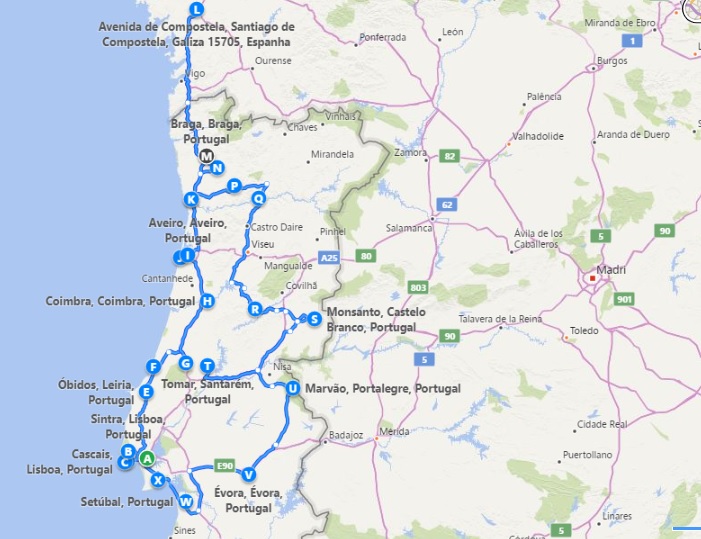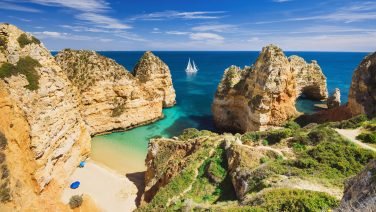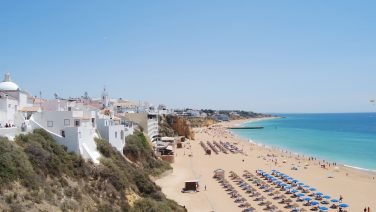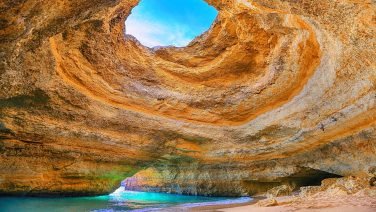


14 Days of Private Tours in Portugal well spent with culture and discoveries throughout Portuguese territory. From major cities like Lisbon and Porto to small and charming villages, this itinerary allows you to experience authentic Portugal — full of history, traditions, unique landscapes, and unforgettable experiences.
This private itinerary will start and end in Lisbon. For any questions, feel free to contact us

Private 14-Day Tour in Portugal — curiosities:
Why do Portuguese sweets — the famous conventual desserts — use so many egg yolks?
The explanation is simple: in the past, egg whites were used to starch clothes. Since this left large quantities of unused yolks, they had to be repurposed — which led to the creation of egg-rich recipes. As a result, Portugal became one of the largest consumers and producers of eggs in the 18th and 19th centuries.
Egg whites were also exported to aid in wine production, where they acted as a natural clarifying agent. And the yolks… stayed here, becoming delicious desserts.
The name “Conventual Sweets” is no coincidence: many of these recipes were created inside convents and monasteries by the skilled hands of nuns.
And what about tempura… isn’t it Japanese?
In fact, the recipe has Portuguese origins! Tempura consists of frying vegetables, fish, or seafood — especially shrimp — coated in a light batter. It was Portuguese Jesuits who introduced this cooking technique to Japan.
During Lent, when red meat was forbidden, the Jesuit missionaries living in Japan chose to eat seasoned vegetables and seafood, dipped in batter — giving rise to what we now know as tempura.
Itinerary
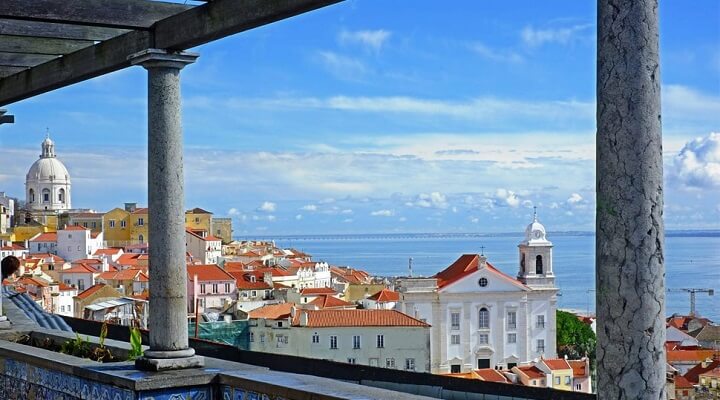
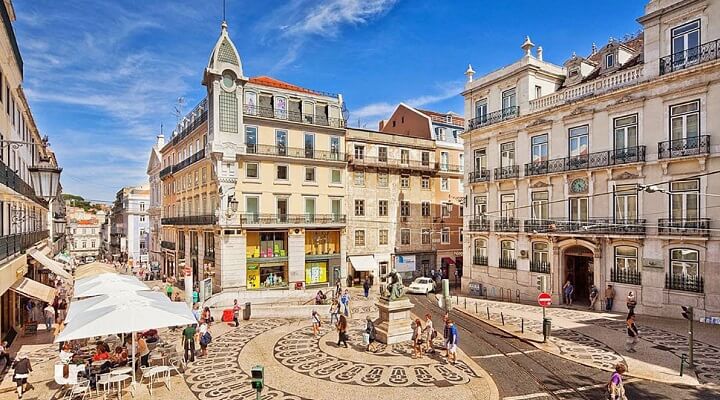
The first day of our Fourteen Days Private Tour in Portugal from Lisbon will be entirely dedicated to the Portuguese capital. Lisbon was almost completely devastated by the great earthquake of 1755, the largest ever recorded in Europe, which led to the creation of a fully redesigned city featuring the first anti-seismic constructions. This is how the Pombaline Downtown was born, organized with straight, perpendicular streets, with Rua Augusta as its main axis.
Many of these streets were named after the trades and crafts of the time — such as shoemakers, goldsmiths, and leatherworkers. Lisbon’s “Baixa” is also notable for the monumentality of its buildings, which symbolize a new social order marked by the rise of the merchant and financial classes. To test the resistance of the new structures, troops would march inside the buildings to simulate the vibrations of an earthquake.
Moving on to Belém, we will visit the area that best represents the Portuguese Age of Discoveries, home to UNESCO World Heritage monuments such as the Jerónimos Monastery and the Belém Tower — magnificent examples of the Manueline style. Nearby, the modern Monument to the Discoveries and the vast Praça do Império reinforce the grandeur of Portugal’s maritime empire.
Belém is also a pleasant place to stroll along the Tagus River, with wide green spaces, marinas, sailing clubs, and bike paths that blend sea air with beautiful scenery. And of course, we cannot miss tasting the famous Pastéis de Belém, whose secret recipe continues to delight visitors from all over the world.
Overnight in Lisbon
In Sintra, we will explore the charm of its narrow streets, traditional shops, and regional flavors — make sure to try the famous Queijadas de Sintra and Travesseiros da Piriquita.
The choice of which palaces to visit will be entirely yours, and your guide can recommend the best option among:
• Quinta da Regaleira – A 19th-century palace with fascinating architecture and strong Masonic symbolism.
• Moorish Castle – A fortress from the 8th/9th century, testimony to the Islamic presence in Portugal.
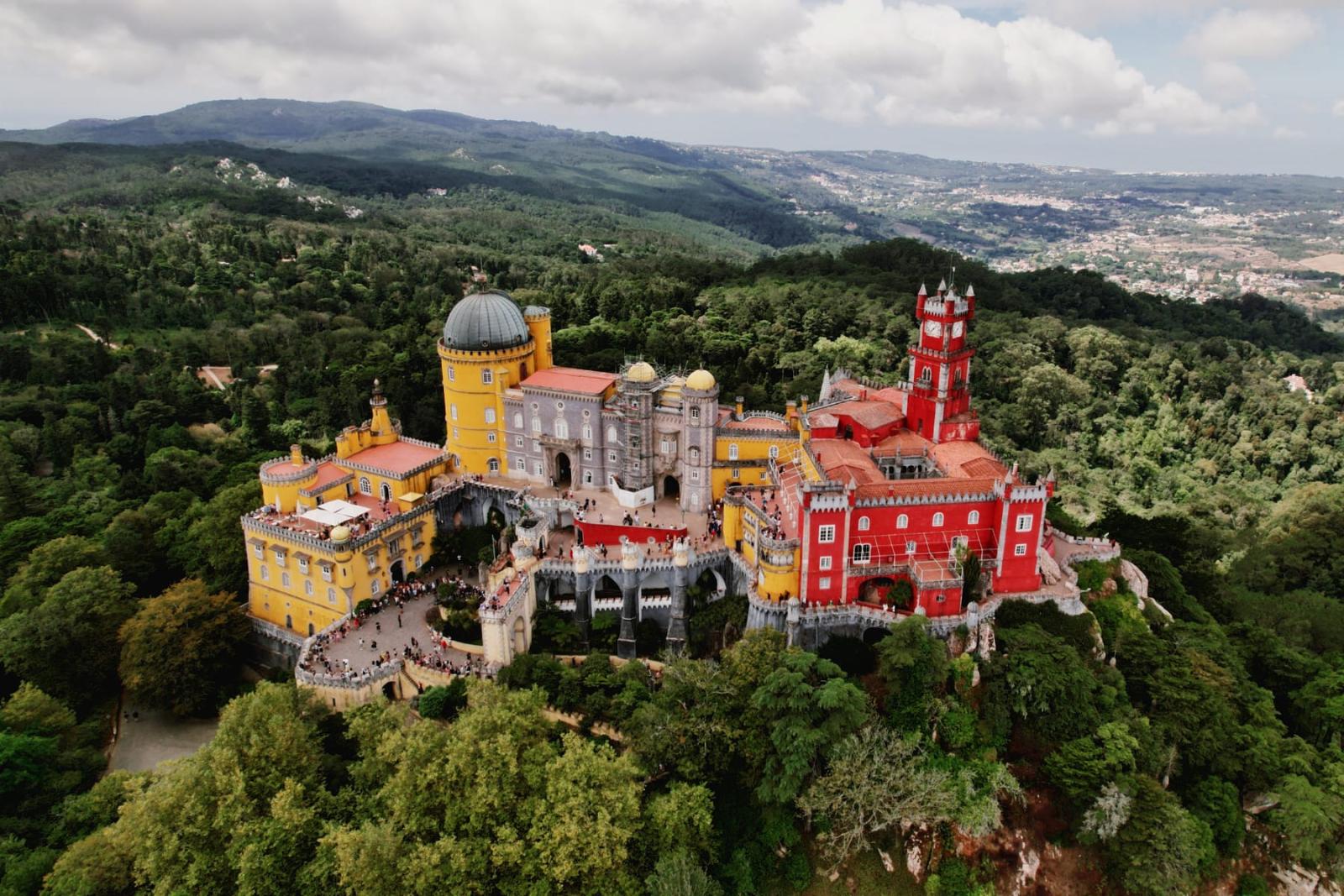
• Pena Palace – An icon of 19th-century Romanticism, born from the artistic vision of King Ferdinand of Saxe-Coburg-Gotha.
We then continue to the impressive Cabo da Roca, the westernmost point of mainland Europe, poetically described by Camões as “where the land ends and the sea begins.” A breathtaking natural setting within the Sintra-Cascais Natural Park.
Afterwards, enjoy time in Cascais, once a humble fishing village and now an elegant seaside town. Nearby lies Estoril, famous for its casino — the largest in Europe — and for inspiring Ian Fleming in the creation of Casino Royale.
We return to Lisbon along the coastal road, offering stunning views over the Atlantic Ocean.
Overnight in Lisbon
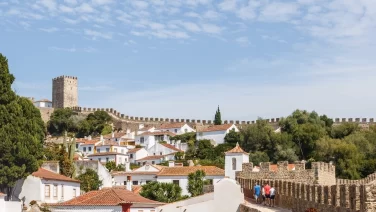
Óbidos has been inhabited since the Paleolithic period thanks to its privileged location near the sea and the lagoon. Phoenicians and Romans passed through here, and King Afonso Henriques later conquered it from the Moors. The town then became part of the defensive pentagon designed by the Templars. Although the 1755 earthquake damaged sections of the walls and several buildings, Óbidos still preserves its strong medieval character today.
Nazaré, once a traditional fishing village, maintains its authentic atmosphere visible in its houses, churches, and the iconic “seven skirts” worn by local women. It became world-famous for the giant waves of the “Nazaré Canyon,” where in 2013 Garrett McNamara surfed a wave close to 30 meters high.
We then continue to the Sanctuary of Fátima, one of the most important pilgrimage sites in the world. Here you may visit (and, if you wish, attend Mass):
• The Chapel of the Apparitions, the heart of the Sanctuary
• The Basilica of Our Lady of the Rosary, where the tombs of the Shepherd Children lie
• The Basilica of the Holy Trinity, a modern and impressive church with over 8,000 seats
We end this day of our Fourteen Days Private Tour in Portugal from Lisbon in the historic city of Coimbra.
Overnight in Coimbra
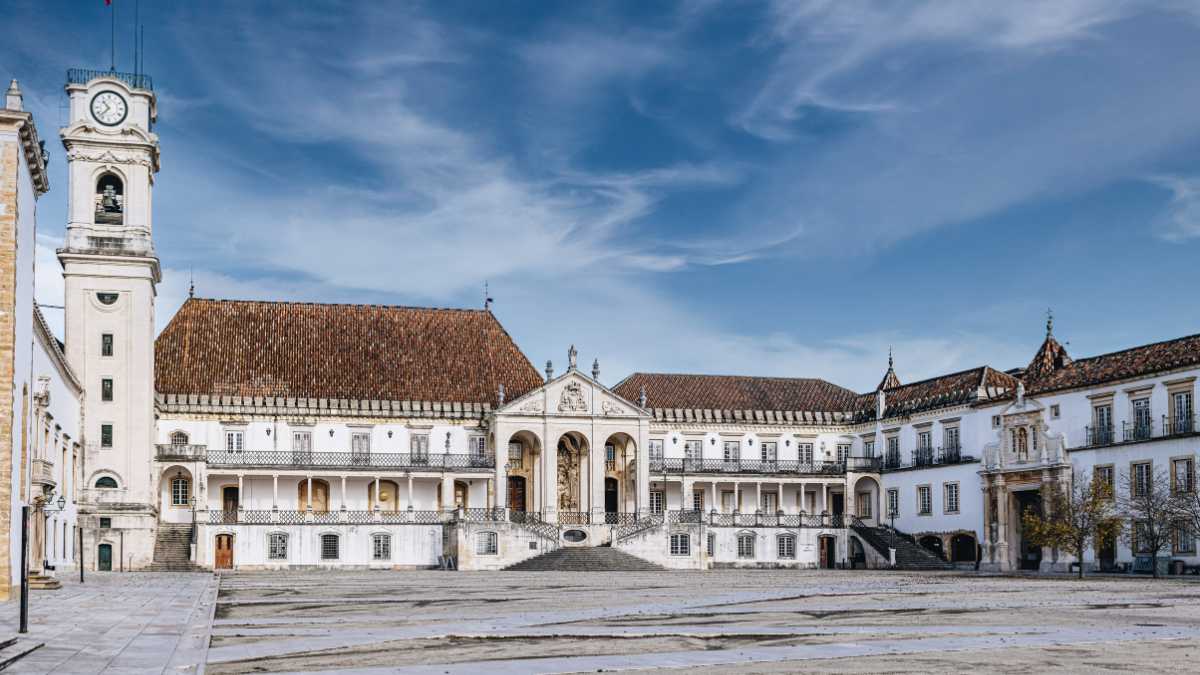
A calmer day begins at the University of Coimbra, one of the oldest in Europe. Its greatest highlight is the Joanina Library, an 18th-century masterpiece built over the former university prison — considered one of the most beautiful libraries in the world. Its interior was completed toward the end of the 18th century, with ceilings painted by Master António Ribeiro and Vicente Nunes, and a portrait of King João V by Domenico Dupra.
After visiting the library, we will continue exploring other important areas of the University, such as the Saint Michael Chapel, the “Sala dos Capelos,” and the iconic “Cabra” Tower.
We then head down to Coimbra’s historic center, located between the Mondego River and the University. Here, charming narrow streets, pretty squares, cafés, pastry shops, and traditional restaurants invite you to relax and enjoy the authentic atmosphere that has been preserved for centuries.
We will also visit major historical landmarks such as the Old Cathedral (Sé Velha), the Almedina Arch, and the Church of Santa Cruz, where Portugal’s first king, Afonso Henriques, is buried.
Overnight in Coimbra
We continue from Coimbra toward Porto, but before arriving we will stop in Aveiro, known as the Portuguese Venice. Here we recommend a traditional moliceiro boat ride to explore the canals that supported the local economy for centuries, from harvesting seaweed to producing salt.
Aveiro’s Market, built in wrought iron and glass, recalls the style of Gustave Eiffel, while the many classified Art Nouveau buildings reflect the city’s historical wealth.
Afterwards, we will visit Costa Nova, famous for its colorful striped houses. Originally built on wooden stilts over the sand, these structures served as fishermen’s storage barns. Over time, many were transformed into charming summer homes, preserving the vibrant stripes that have become the area’s hallmark.
Overnight in Porto.
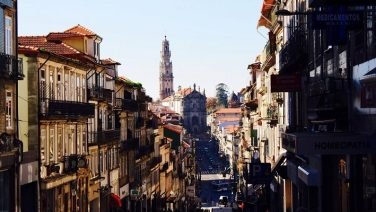
We will start the day on Avenida dos Aliados, the heart of the city, known for its monumental buildings and the Town Hall. We then continue to the Lello Bookstore, an architectural icon admired by literature lovers and often associated with the period when J.K. Rowling lived in Porto.
Next, we visit São Bento Station, famous for its more than 20,000 tiles by Jorge Colaço depicting important moments in Portuguese history. We continue to the Porto Cathedral, one of the city’s oldest monuments, featuring Romanesque origins with Gothic and Baroque additions.
Another highlight is the Church of São Francisco, renowned for its extraordinary gilded woodwork—where it is believed that more than 300 kg of gold dust were used—and its remarkable sculpture, the Tree of Jesse.
Finally, we cross to Vila Nova de Gaia, home to the traditional Port Wine cellars. Here, we will enjoy a guided visit and tasting to learn the full process, from the harvest to the final product.
Overnight in Porto.
Today we leave Porto and head towards Galicia, Spain, beginning with a visit to Vigo, where we can stroll through the famous Pescadería. You may even choose to have lunch in one of the local restaurants and try the iconic oysters from the Vigo estuary, traditionally served fresh with just a touch of lemon and a good wine.
We then continue to Santiago de Compostela, an emblematic city that welcomes pilgrims from all over the world seeking peace and spirituality along the Camino de Santiago. You will have time to explore the city, including the Cathedral and its museum, as well as other cultural sites such as the Museum of the Galician People, the Museum of Pilgrimages, and the Galician Center for Contemporary Art, designed by the Portuguese architect Álvaro Siza.
At the end of this day — the seventh of our Fourteen Days Private Tour in Portugal from Lisbon — we will return to Porto.
Overnight in Porto.
Guimarães, the first capital of Portugal, will be our first stop. We will explore the historic city, where the statue of King Afonso Henriques, the first king of Portugal, welcomes us. We will visit the Guimarães Castle, the Church of São Miguel, and the Palace of the Dukes of Bragança.
Afterward, we will stroll through the medieval streets that still preserve the atmosphere of centuries past, ending in the most iconic squares such as São Tiago, Toural, and Oliveira. Before leaving, there will be time to taste the traditional Santa Clara pastry.
We then continue to Braga, a modern city with a rich Roman and medieval heritage. We begin at its impressive Cathedral, dating back to the 11th century, where the cross used in the first mass celebrated in Brazil is kept. We will also visit the altars, pipe organs, and funerary chapels that hold the tombs of notable archbishops and of the parents of Portugal’s first king.
After that, we will head to the Sanctuary of Bom Jesus, famous for its water-powered funicular, the only one of its kind still in operation in the world. This ingenious system works through the weight of the water and the passengers, making the ascent and descent a truly unique experience.
Overnight in Porto
On this day of our 14 Days Private Tour in Portugal from Lisbon, we leave Porto and drive to Amarante, where we will visit its historic center, with ancient streets, traditional houses, and the beautiful scenery along the river and the S. Gonçalo bridge. For architecture lovers, Amarante offers several examples of Romanesque style and medieval constructions, including the Church and Convent of São Gonçalo and the Amadeo de Souza-Cardoso Museum.
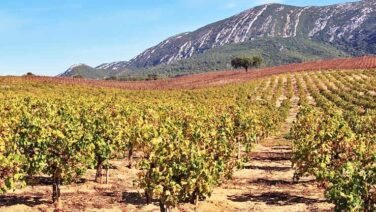
We then continue toward the majestic Douro Valley, considered by many to be one of the most beautiful regions in the world. This is a landscape where wine culture blends harmoniously with small villages and stunning natural scenery. It is the oldest demarcated wine region in the world, famous for its Port wines and excellent red and white table wines.
Next, we will visit the Pinhão Railway Station, renowned for its traditional tile panels depicting local traditions, from the harvest and grape treading to the transport of wine in the typical rabelo boats.
We end the day with a visit to a local winery, where you will learn about the production methods and enjoy a tasting of some of the region’s best wines.
Overnight in the Douro Valley
Today we leave the Douro Valley and head toward Monsanto, considered the most Portuguese of all Portuguese villages. Before that, we will stop in the Serra da Estrela, the highest point in mainland Portugal and one of the country’s most impressive natural landscapes.
Serra da Estrela Natural Park is the largest protected area in Portugal, with unique scenery, deep valleys, crystal-clear rivers, and a strong pastoral tradition. It is also home to the famous Serra da Estrela cheese, produced under strict rules that guarantee its unmistakable flavor and quality. Whether in summer, with its green pastures, or in winter, covered in snow, the mountain range is always breathtaking.
We then continue to Monsanto, a truly unique village built among massive granite boulders. At the top, the Templar Castle dominates the landscape. As we walk through the narrow streets, we find traditional stone houses, small chapels, ovens, cisterns, and shops with local products. Despite its medieval appearance, Monsanto has a lively and welcoming atmosphere, preserving traditions and an authentic character.
Overnight in Monsanto
Today we travel from Monsanto to Tomar to understand the importance of the Order of the Templars in the formation of Portugal. We will visit the impressive Convent of Christ, whose entrance portal is a true Renaissance masterpiece by João and Diogo de Castilho. Inside, we find the Charola, the first Templar church built by Gualdim Pais — an octagonal space where the monks once walked in prayer.
During the 16th century, at the height of the Portuguese Discoveries, the complex was expanded in the Manueline style, with the famous Chapter Window as its most iconic feature. Classified as a UNESCO World Heritage Site since 1983, the convent brings together centuries of history and a blend of Romanesque, Gothic, Manueline, Renaissance, and Baroque architecture.
We will also visit the Church of Santa Maria do Olival, founded in the 12th century by Gualdim Pais. This church served as the headquarters of the Templars in Portugal and as the pantheon of its masters.
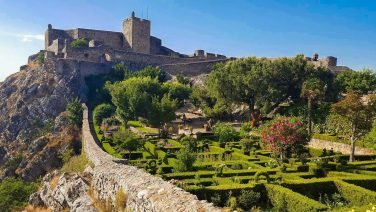
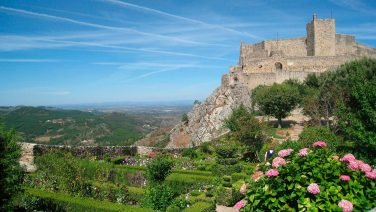
After some free time for lunch in the center of Tomar, we continue to Marvão, one of Portugal’s most enchanting and dramatic hilltop villages, situated at about 800 meters of altitude. Its strategic position once allowed control over the Sever River valley, making this region the stage of numerous conflicts throughout history.
The impressive Marvão Castle, the Convent of Nossa Senhora da Estrela, and the Roman ruins of Ammaia are some of the highlights. The village preserves an authentic medieval atmosphere, with sweeping views that stretch across the landscape until the border disappears on the horizon.
Overnight in Marvão
Estremoz, known as the “white city” of the Alentejo, owes its name to its bright houses and the numerous marble quarries that have made it one of the world’s leading producers of this resource. Just 50 km from the Spanish border, it is protected by two rings of walls: the oldest, from the 13th century, surrounding the medieval castle, and a second fortified line defending the lower part of the city.
Its heritage is remarkable: the Old Town, the medieval Castle, the former Royal Palace (now a Pousada), the Chapel of Queen Saint Isabel, the Convent and Church of São Francisco, the Church of Santa Maria, and Dom José I Square, known for its traditional market.
We then continue to Évora, a city shaped by centuries of history, from its narrow streets of Arab origin to the golden age of the Discoveries, when noble palaces and the historic Jesuit University were built. Among its most iconic monuments is the Church of São Francisco and the famous Chapel of Bones, lined with the skulls and bones of around 500 monks, greeting visitors with the haunting phrase: “We bones that are here, for yours we wait.”
Overnight in Évora
Today we continue exploring Évora, visiting the places we didn’t have time to see the day before, along with a visit to a cork factory and the medieval village of Monsaraz.
Cork is the bark of the cork oak, a unique tree whose bark grows every year but can only be harvested every nine years, reaching up to 25 cm in thickness. Light, resistant and an excellent natural insulator, it protects the tree from heat, cold, and fire.
Did you know that Portugal produces 55% of the world’s cork? Besides wine stoppers, cork is highly valued for flooring, wall coverings, sports equipment, and decorative items.
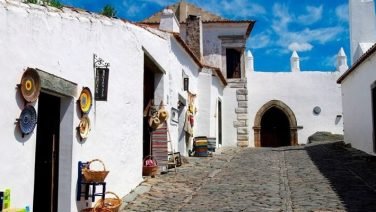
We then continue to Monsaraz, one of the most beautiful medieval villages in Portugal, with cobblestone streets, whitewashed houses, and an atmosphere that transports visitors back in time. From the top of its walls, the view over the Alentejo plains and Lake Alqueva is truly unforgettable.
Overnight in Évora.
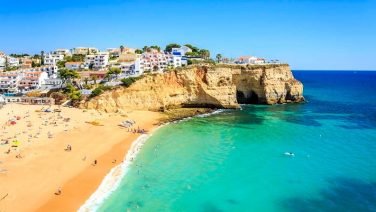
The Arrábida Natural Park reveals a stunning contrast between the white limestone cliffs, the deep blue of the sea, and the green of the mountains. This blend of colors creates unique landscapes that change with the seasons. Along the coast, you will find some of Portugal’s most beautiful beaches, such as Figueirinha, Portinho da Arrábida, Galapos and Galapinhos, the latter elected Best European Destination in 2017.
Because it is impossible to remain indifferent to Portugal’s tile tradition, we will also visit a traditional tile factory, where you can learn about the entire artisanal process—from molding to painting—and even try painting your own tile, inspired by European, Islamic, or Hispano-Arabic styles from the 15th and 16th centuries.
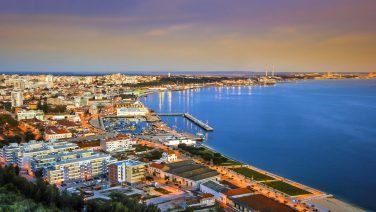
We then continue to Setúbal, a city deeply connected to the sea. Fishing boats, the river, and the ocean are part of its identity, reflected along the waterfront and in the daily life of its inhabitants. In the historic center, modern shops blend with long-established local businesses full of character, while culture appears at every corner through architecture and lively streets. Most roads lead to Bocage Square, the main meeting point for locals, filled with outdoor cafés and marked by the statue of the poet, always facing the sea.
End of our Fourteen Days Private Tour in Portugal from Lisbon.